Marriage

Cancer changes relationships. I was once told a story about a lady diagnosed with breast cancer about 30-40 years ago. She was probably about my age and given 6 months to live. It turned out she lived longer than that (and is still alive in fact), but for the longest time she was never really given the “all clear”, like okay now we know you’re going to live for decades longer, not months. So 9 months would pass…then doctors would say, “Well you keep hanging in there, but you still only probably have a few months”. The story goes that at some point fairly early on she “picked” a future spouse for her husband, a family friend or something along those lines. Time goes on, she doesn’t die, and her husband ends up having an affair with the replacement. The lady and her husband get divorced, he ends up marrying the replacement, and the kids get very resentful and stop talking the husband. This story, like so many I’ve heard about the lives of cancer patients and fallout of a cancer diagnosis, does not surprise me at all. Once you get diagnosed with cancer a cloud of never-ending uncertainty will hang over you and those around you.

This year my husband and I are celebrating our 14th year of marriage.  The longer I am married, the more I realize 1) marriage is hard (duh!) and 2) marriage is kind of a crap shoot. People change, in pretty major ways and in ways that put stress on the marriage, whether it be mild or extreme.  I also observe that inevitably you and your spouse are going to split ways on one or more of the values and expectations that you thought you had all squared away before marriage. Kids change things in very complex ways.  On one hand, kids bring a common goal to the relationship.  You both want what’s best for them and, like a complicated, huge, life puzzle, you want to work together to navigate the best way to parent your children.  You really want to put them on the best life path you can and do everything in your power to make them feel loved and resilient.  Kids bring shared joys and memories.  They bring this new love and excitement that can be really bonding for parents.  On the other hand, no two people are ever going to parent the same way or agree on every parenting decision.  And because kids are so important and valuable to parents, even the slightest difference of opinion can become a major source of tension.  What I did not realize going into our marriage is that my husband would have so much confidence in child rearing (right out of the gate…like he thought he was an expert from day one….and in many ways it seemed like he was) and I would feel so incompetent.  Breast feeding only intensified this phenomenon.  As many women who breast feed will probably tell you, breast feeding an infant is one of the most difficult and rewarding things you might do as a mother and is extremely difficult and frustrating at the onset.  Things generally do not go well from the get go with the first baby.  In my case, my poor little baby was born on the small side and so any weight loss (which is normal after birth) was regarded as an emergency (not really, but in our eyes it was).  My first born and I were having a terrible time getting him to consume any breast milk the first few days and he was not only miserable but also dropped to less than 6 lbs.  We weren’t getting any sleep and finally in the middle of our 1st night home my husband, the baby expert, took our newborn and majestically gave him formula and single handedly “saved his life”. This made me feel like the biggest flop of a mother out there.  I remember the next morning, at one of my most beaten down, downtrodden moments of motherhood, my husband, the baby expert, renaissance man that he is valiantly displayed the bottle to me and claimed “HE LOVED IT!”.  Point being, I would say for my husband and I, the first year of parenthood was the most difficult of our marriage (he does not agree with this at all, but again, I think he was high on “daddy” hormones and his natural, God-given talent of being a dad).  Through the years, as I’ve found my way in motherhood and gained more confidence, we have different battles, but I feel we’re on a more level playing field.

When preparing for marriage, we attended a very short workshop at a church, just to cover all the “premarital counselling” bases.  One thing I remember is one of the teachers was telling us a story of how her husband was making a list of all of her faults one day.  I was aghast, that sounded terrible to me.  I felt like I already kept a pretty hefty tabulation of all my faults ready at moments notice to interfere with my goals and crush my dreams.  I definitely didn’t need to add this dynamic to my life.  And really, I found it hard to believe either my fiancé or I would ever stoop to the level of calling out your spouse’s faults.  Well, 14 years into marriage, I can tell you some days all we do is revel in each other’s shortcomings.  But for better or worse, we are a team, and I know we will always be committed to our partnership in this family. 

I felt I should give my husband a fair shot in this marriage opinion piece, so I asked him.  “If you were writing an article about your experiences with marriage, what you be your main points?”  To which he answered, “I guess I’d say you forget what you fell in love with.”  Dead silence.  I get what he was trying to say, but what?  So, I guess you have that.  Maybe he can wordsmith that into a loving essay someday.  As for me, without a doubt, within a snap of a finger, I know exactly what I fell in love with.  His humor, it’s the best.  So, there you go, Travis.  I remember exactly.  I appreciate his humor so much, that when I think of his flaws (which I do daily, it’s part of my job as a wife)…I always come back to his quick wit and ability to entertain and lighten the mood of whatever crowd he is in.  As much as Travis likes to portray a dark and brooding mysterious character, he is very much the extrovert to my introvert.  While I want to duck into a corner in the fetal position and cover my neck tornado-drill style when I enter a room full of people, Travis lights up like a Christmas tree.  This combination doesn’t always work with other people.  For me, and probably most other introverts, extroverts can drown me out and seemingly take away my voice in a relationship.  In Travis, I have found my unicorn.  Somehow he is able to use his sparkle to light up a room and help me feel comfortable in groups and yet still maintains the patience and understanding to listen to me and make me feel heard.    

As I’ve observed other marriages and reflect on how my cancer diagnosis has affected our marriage, I would say overall the cancer has brought us into a closer partnership.  That is not to say that cancer doesn’t bring its own challenges to a marriage.  I’ve gone through some dramatic physical changes that I’m sure my husband did not see coming when we got married.  I’ve lost hair, gained and lost weight depending on treatments, and lost both of my breasts.  The constant appointments, health care decisions, and ever changing discomfort and treatment side effects that I experience all take their toll on both of us.  While I don’t think hospitals and cancer are enjoyable for any spouse, Travis seems to have a particularly strong discomfort with medical problems and the healthcare system and to ask him to be my primary partner in all of this is hard.  And on top of that, I just don’t have the energy and stamina that I did pre-cancer. So not only do we have all of the stress of a terminal illness diagnosis, but he also has to pick up the slack of normal life when I’m not up to it. And he does all of this without complaint.

As morbid as it sounds, sometimes in the back of my mind I feel like I’m prepping him for being a single parent.  Does he know how the boys’ schedules work and how they might change?  Is he ready to make arrangements if I do end up in the hospital or worse sooner than we expect?  Does he understand and respect my parenting well enough to continue my influence if I’m not around?  Is he resilient enough to carry on and be the steadfast leader of the family he may need to be much sooner than he expected when we said our vows 14 years ago? We are living the “in sickness” vows every day and it really challenges us at times.  That being said, there are definitely “mid-life crisis”-like issues that I assume would be more at the forefront of our marriage if we didn’t have this cloud of my mortality hanging over us and distracting us.  I am thankful that we have taken more time to enjoy each other, travel together, and grant each other grace because we know our time together may be limited.  I’m not sure why it takes a cancer diagnosis to stop and smell the roses, but sometimes it does, and for that I am grateful. 
Everything’s Going Good. Summary of Recent Scans and Other Notes

Since my last post I’ve had a couple really good scans. Everything is stable. Since I have been on a good streak with scans, going forward, when news is good I am going to try to indicate that in the title of the post (rather than something unsettling like Results of Scan…). Hopefully that alleviates any momentary anxiety and frankly if you just don’t have time to read further, that’s all you really need to know. No changes, which is excellent! At this point my next scan is scheduled for January 2022. Because I am accumulating quite a few unfinished short ramblings, I’m going to throw some of those in this post and then I’ll have another post about COVID fallout/hospitals and marriage (get excited Travis) coming soon.

The In-Between

On the bright side, you don’t have cancer, you’re not dying.

Maybe not, but I’m living like it and that might be worse.

Kayce and John Dutton, Yellowstone

I don’t care who you are, a cancer diagnosis will change you and those around you. It will change your priorities, how you live your life, and how you look at life. I have noticed that the longer I continue to go with good scans, the more I find myself a little adrift mentally. Like most other people, I strongly feel I am still recovering from all that is COVID. As little as that has to do with cancer, I fully acknowledge that there has been a blanket of fog and uncertainty over all of humanity for the past 18 months. COVID aside, there are definitely some cancer-related feelings that I’m experiencing. There’s a theory that when you give a problem a name, it helps you deal with it. I have a few things going on that are probably pretty common in cancer patients, but pre-cancer, I never would have realized people with cancer have these feelings. One is the shame of cancer. Michelle Zauner touched on this in her book about her mother’s battle with cancer.

Anything seemed possible if you just had an optimistic attitude. Maybe we hadn’t tried hard enough, hadn’t believed enough, hadn’t force-fed her enough blue-green algae. Maybe god hated us. There were other families who had fought and won. We had fought and lost-and among all the natural, heartbreaking emotions we had expected to feel, it also felt strangely embarrassing.

Michelle Zauner, Crying in H Mart

All of these feeling resonate with me and as happy as I am with my current status, I am aware with a persistent trepidation that all of these feelings of shame will come rushing back if and when the scans aren’t so good.

Another issue is survivor’s guilt. Like, why am I still alive? When I was first diagnosed, my mind immediately went to worst-case scenario, just a few short years left. This happens to many metastatic breast cancer patients. And yet, here I am, still hanging out. I should be so thankful and grateful for my health everyday I keep going, but sometimes those feelings are difficult to come by and then I feel ashamed for the “hard” days when the gratitude doesn’t come easy. Sometimes the weight of it all seems to overpower my cheerfulness and hope. Every time that happens, I get frustrated.

The third thing I’ve touched on before, the constant state of flux. Not knowing what the next years will hold can become overwhelming and the ups and downs of the new COVID world has certainly not helped. I asked my current oncologist about my prognosis a few years ago and she said, “Well, we have a saying in oncology, ‘The longer you go… the longer you go'”. Wow. Catchy. Who the heck is comforted by that? I realize cancer can be extremely volatile and unpredictable, but gee whiz, that’s the saying that the oncology community has come up with?

As frustrating and irritating as all of these feelings can be, I think ultimately this mental unrest and discomfort in my head will lead to good places for me. When I was first diagnosed, I wanted to make sure I enjoyed what life I had left. I really wanted to focus on my bucket list, mainly travelling. I also wanted to take advantage of my physical abilities (running) while I still had them. While I still maintain “having fun” as one of my priorities, I have started to think about ways I can give back and engage in more purpose-driven, worthwhile projects. I think this is a result of realizing I’m still feeling pretty good and I am probably not dying anytime soon. I have some time and opportunities to make the rest of my existence a little more meaningful. I’m pretty sure there are some great ‘seeking out discomfort for personal growth’ quotes I should insert here, but a quick internet search produced only mediocre results. So here is my quote/personal pledge to myself: I will accept and embrace the discomfort because I know that these feelings must happen to learn, grow, and find contentment and peace. More to come on that journey as I continue to contemplate different ways to give back.

Breast Implant Fun

News on the cancer front continues to be positive for me. Everything is stable. The only medical issue I am facing, which is somewhat cancer related, is that one of my breast implants ruptured. Apparently it was an internal rupture, meaning it was contained by tissue surrounding the implant. I have no symptoms and probably would never have known at this point other than a plastic surgeon reviewed some of my CT scans last fall and caught it. While she indicated that dealing with this (exchanging for a new implant) is not something that has to be done immediately, she said that when they see it, they feel like they should probably address it. On a scale of 1-10 with 1 being not an issue at all for me and 10 being medical emergency, this is about a 1.5. I don’t really have any desire to do anything about it, but since I’m feeling pretty healthy otherwise and would like to prevent complications that might arise from a ruptured implant, I’m planning to do the exchange in about a month.

The plastic surgery consult was pretty amusing to me. Other than my breast implants following the bilateral mastectomy, I’ve never really considered plastic surgery. Not that I’m against it. I’ve just had more critical health issues that have come up at a relatively young age, so it has never been much of a thought for me. Anyway, back to the consult. When my plastic surgeon brought up the implant exchange, she suggested I consider whether I might want to exchange the other implant also since I’m already going to be sedated, they are opening me up, etc. Why not kill 2 birds with 1 stone instead of possibly undergoing another surgery in a few years or suffer complications in the event the other implant ruptures? This idea alone kind of blew my mind….I mean why fix something that isn’t broken? Or do they expect it to rupture? Is she just trying to drum up more business? In all honesty, I don’t think she was trying to pressure me into excessive surgery, I think she was just trying to cover her bases and inform me of all the different options. Things really got crazy when she brought of the idea of “smoothing things out”…scar lines, etc. by using fat from my abdomen. WHAT?!?

Me (thinking): What did I just hear? Liposuction? To my stomach? The exact problem area of most women, but especially those of us who have been pregnant in the past? The especially problematic area for people like me that gained over 50 pounds with each pregnancy? Removing the layer of fat that just sticks there…no matter how much weight is lost? That can’t be right? To be so casually mentioned….? What is going on? Where am I?!?

Me (aloud, after composing myself): “So…..so, are you? Are you saying you would take fat from my stomach and add it to my chest?”

Plastic surgeon: “Yes.”

Me (obviously she doesn’t get the gravity of what we are talking about, I need to act it out): “So.” Clearing my throat and pointing at my stomach. “You would take fat from here. And put it here (pointing at my chest).”

Plastic surgeon: “Yes.”

Me (talking very slowly now for complete understanding and maintaining strict eye-contact to show I mean business): “So, my waist would get smaller and my chest would get bigger?”

Plastic surgeon: “Yes.”

Please, women who might be reading this article, pause for a moment to consider what is being offered. The holy grail of fat redistribution; less in the waist and more in the chest (or “bosom”).

At this point I started laughing hysterically and the plastic surgeon started to look uncomfortable. When she realized I was indeed laughing, not crying, she started to awkwardly lightly chuckle along side of me.

So many things about this….

While after childbirth I did experience a dramatic desire to get several pounds of fat hacked off of my abdomen and have noticed over the years that there seems to be an everlasting layer of fat around the abdomen that is just stuck there…forever; I would never in a million years have thought I’d be having a discussion with a surgeon about liposuction to the area. I don’t even make time for haircuts (I get 2 per year) or wash my hair (1-2 times per week). And in the spirit of continuing my minimalistic ways, I am strongly leaning towards just doing the bare minimum in this surgery, which would be just replacing the one ruptured implant. But, I continue to look back on the conversation with amusement. Breast cancer continues to be a journey for me and I can’t help but smile that the journey at this point in time includes conversations with a plastic surgeon about liposuction. I’m pretty sure it doesn’t get any better than this for a metastatic breast cancer patient.

Hope

As 2020 winds to a close, I am filled with excitement and hope. Like most other people, I sit in amazement that my family and I actually made it through 2020. Looking back at it, I compare the whole experience of the onset of the coronavirus to being thrown in the deep end of a swimming pool and being told to just hang out there until told otherwise. And little did most of us suspect that being told otherwise would never really come. I have never felt this feeling of accomplishment from simply “making it through a year of life”. And yet, as someone who’s been battling metastatic cancer for almost three years, I should probably start feeling that way every year. And I do feel that way this year, more than ever. When I was diagnosed in March 2018, I figured given the fact that the only affected organ of metastasis was the bones that I would probably have a good chance of living beyond the 2-3 year life expectancy of the average metastatic breast cancer patient. But, to be almost three years out with no evidence of cancer in my scans is really amazing to me. If nothing else I suspected I may develop cancer in another area of bone that would cause some disability, but I’m still running! I’m pain-free! Sometimes I can’t believe my good fortune in terms of cancer and with a little light at the end of the tunnel of this pandemic, I can honestly say I’ve never been filled with this much hope.

Aside from the obvious pandemic issues of virtual-everything and constant worry about susceptible loved ones and those really suffering from isolation, 2020 has been a challenge for me as it has been with everyone. After completing races in 31 states, I had to cancel one planned trip to complete 3 more states and also give up thoughts of completing more later in the year. We had a family trip to Europe in March cancelled and are still working on getting reimbursed for airline tickets. On top of those disappointments my health did take an unexpected, slight downturn in August when an infection flared up in my ribs and caused countless appointments, procedures, and therapy. Looking back at it, everything went really smooth with the antibiotic treatments and really what better time to be tied down with doctor appointments and a new medication regimen then in a pandemic when you can’t really go anywhere or do anything else? But, I’m glad it’s over; excited to get back on my cancer treatment; excited to plan races again; and just excited and thankful to continue living this crazy life. I am ready to say good-bye to 2020 and welcome 2021, a New Year full of hope!

Chest Pathology Update

I will preface this with admitting that I feel a little self-centered writing this with all that is going on in the world right now. This is solely informative for those curious. The world is a heavy place right now, I realize we’re all struggling to cope with how to function and my intention is definitely not to take away from that. That being said, here’s the scoop:

After almost three months of scans, biopsies, appointments, and surgeries; I finally have a diagnosis. I have an infection caused by the common bacteria, staph aureus in my rib cartilage and pleural space. I am not sure if it has been specifically diagnosed as this; but my infectious disease doctor equates it with a condition called empyema necessitans if you want to Google it. I have no idea how this happened. As a cancer patient, I am immunocompromised; so I am more susceptible to any type of infection. Other than that I did have some type of lung infection in early May (I was COVID tested at the time because it seemed very similar to COVID), but I don’t see a strong connection there either.

On the cancer front; the good news is that this is definitely not cancer. In addition to a regular CT-guided/needle biopsy performed in September, additional tissue was collected and analyzed after my recent surgery last week and it was also confirmed to not be cancer. The bad news cancer-wise, is that I do have to withhold one of my cancer medications while I have this infection because that specific medication (like most cancer medications) lowers my white blood cell count and thus my ability to fight infection. While it is always unsettling and frustrating to take a pause in my medication regimen that has been working so well for the past few years; these type of interruptions are fairly common and it’s probably not the end of the world.

On the non-cancer, regular person front; this is terrible. I found out yesterday that I have to be on IV antibiotics for 6 weeks. This will be done through home infusion. I will have a PICC (peripherally inserted central catheter) and give myself an antibiotic 3 times a day. I have a fairly stoic, aloof personality; so I’m guessing I didn’t come off as the dramatically upset hot mess of a person I felt like on the inside when the infectious disease doctor told me this; but I was definitely emphasizing to him that this is a huge quality of life issue for me. Are you sure we need to do this? Can I work? Can I run? Do you mind if I just start laughing hysterically while you tell me I can only lift 10 pounds for six weeks knowing I have two active boys and am constantly getting groceries, cooking, doing housework, doing laundry, etc (not that any of those activities generally involve lifting more than 10 lbs, but I think we can all agree, the need to lift more than 10 lbs comes up more than we realize). Heck, I regularly lift up to 40 pounds for my job as a pharmacist as weird as that seems.

One thing thing I constantly battle is the giving up control of my life on multiple levels–my time, my finances, my career, my family, my retirement plan, the seemingly endless health issues that seem to come up as a result of cancer. I don’t think this is really unique to me in any aspect. We all go through this. I do believe people in my situation with a permanent or terminal health condition do fall more in the “less control” end of the spectrum though. I also believe from the little I’ve interacted with those in my situation that we become resilient because of it. Figuring out how to: at a minimum, function; and at a maximum, thrive in this constant state of chaos is a badge of honor that I feel anyone who’s been through distress, whether they are sharing it or not, can wear proudly. I hope at the end of this 6 weeks, I will feel better and look back on this and proudly think “I got through that with the help of God”. I hope we will all be thinking that whenever we make our way out of the coronavirus-dominated world we are living in now.

It’s not cancer…

The past month of my life has been one of the crazier times I can recall. I reported about a month ago that a new spot appeared on my ribs in my routine PET scan. I initially spoke with the nurse practioner about this and she indicated (very empathetically, of course), that this wasn’t really a big deal. A bump in the road, yes; but all things considered, this was near best case scenario for me. I then followed up with my oncologist who basically said the same thing. We looked at the images together, indeed there was a very bright spot that was presumed to be cancerous given my history. Because a new spot of metastasis indicates my current medication regimen is losing effectiveness, I discussed a few different treatment options with my oncologist. One being changing my hormone therapy and changing my targeted therapy to one that had significantly more side effects; another being radiating the area of ribs (this wasn’t really recommended unless I had extreme pain because it wouldn’t really stop the other micro-metastases that were presumed to be happening due to this spot showing up); and finally a clinical trial where I would be given a different hormone therapy and then either given a drug in the same class as my current targeted therapy or given placebo. The point of the clinical trial was to determine whether it made sense to continue with a targeted drug in the same class as my current targeted drug, even though the cancer was starting to prove resistant to my current regimen.

It turns out the spot isn’t cancer and we don’t really know what it is or why it showed up on the PET scan. If you are pressed for time, that’s all you really need to know and can just stop reading right now because the story as to how and why this happened is long and confusing.

This is all really long and confusing, but take-home points: after multiple scans and a biopsy, I was diagnosed with metastatic breast cancer 2 1/2 years ago due to a metastatic spot in my manibrium. Once you are declared metastatic, it is assumed that the cancer will spread at some point, thus the reasons for routine scans. I have difficultly explaining this to people. While cancer can be cured in the early stages, once it has left the primary organ, it is considered to have penetrated the whole body and it’s only a matter of time before it shows up elsewhere. So, while my original metastatic spot in the manibrium was a surprise and we needed to follow-up with a biopsy because at that point I was considered cured from Stage 2 cancer; additional metastatic spots in a stage 4 patient do not warrant the same type of invasive investigations. Second point: although news of the cancer popping up again was upsetting considering I had gone so long without anything, this was completely expected in the world of cancer and a slight modification of my treatment was not earth-shattering, again because it seemed to be still confined to the bones meant my prognosis was still favorable. Third point: I basically had 2 options at this point, start a slightly harsher medication or go on a clinical trial. I chose the clinical trial. Had I not chosen the clinical trial, this whole post would be about 2 sentences…assume cancer spread, started new medication, will follow-up with scan in 3-6 months.

I had to do a number of things to make sure I qualified for the clinical trial. Initially I had to get labs, have an EKG done (because one of the study medications has a rare side effect of causing life-threatening heart rhythm disturbances…this is pretty common with a lot of medications, they just need to make sure you are not predisposed to heart issues), and get a baseline CT scan. I did all that and then followed up with my oncologist a few days later. My oncologist informed me that we had run into a few road bumps with the results of these tests. One, my heart rate was apparently too low for the study. It was in the 40s and needed to be above 50 on an EKG per the study parameters. So, I need to repeat the EKG. My heart rate is generally low because I’m a runner, but it’s usually over 50, so we thought this was a fluke and repeating an EKG wasn’t really a big deal. I also needed more investigation of my heart because my heart rate was so low, so the cardiologist signing off on the study wanted to see an ECHO, or ultrasound of my heart, to prove that my heart was okay. I guess scheduling the ECHO was more complicated than the EKG and couldn’t be done for 9 more days. In the clinical trial world, this put my previous PET scan out of the time-frame specified for base-line scans, so this led to a need for a follow-up bone scan to take the place of my now-outdated PET scan….confused yet? The other issue that had come up was that my CT scan indicated the spot on my ribs looked more like infection or inflammation than cancer. This was a surprise since the PET scan looked very much like cancer and in the words of my oncologist…”I don’t know how you could have an infection there…but I guess we could biopsy the area”. Essentially it was up to me. A biopsy is a big deal. There is a reason they don’t go around biopsying every new area that shows up on a scan in a stage 4 patient. I decided to go ahead with the biopsy, because as sure as my oncologist seemed to be, I felt something was off about this whole thing.

Oddly enough, in the early stages of my rib pain, which started to present about 2-3 weeks before my scan, the possibility of an infection or some type of complication with my breast implant crossed my mind. I kind of ruled this out, however, when I didn’t seem to be displaying any of the classic signs of infection, specifically my temperature and white count were normal. A week or two before my PET scan, the fear and uncertainty of this being cancer started to creep in (see Scan Results August 2020) and when I was told it looked like cancer, I figured that was the most logical explanation. I had a couple weeks of “down time” between the scan and starting the screening process for the clinical trial and noticed that the pain started shifting from a more interior rib pain to a more superficial pain. I also started developing something that kind of looked like cellulitis in the area, it started to look inflamed. It was almost like the spot had moved, which seemed odd if nothing else.

The other issue happening in my life was I had reached a breaking point with working full-time, having metastatic breast cancer, and now starting to work through virtual schooling with my kids. This report of a new spot of cancer (even though, again, it was really not a big deal) basically sent me over the edge and I started the process of quitting my job (or at least drastically reducing my hours). My job is pretty specialized, so quitting my full-time position isn’t an overnight process…it will take months of hiring and training a replacement. My job is important to me. I am very aware of the severe emotional and psychological fall-out that can happen by quitting. Everyone is different, but for me I equate quitting my job with losing a key piece of self-worth that is giving me the fortitude and strength to keep going through this breast cancer journey. I’m not saying it’s right to use your job as this much of a crutch to your self-worth and certainly I have the confidence that I can and will find other ways to use my time, but I am very aware that this can be an issue for me. Although I had started the process of decreasing my workload, I put everything on pause when things started to feel abnormal. That was a difficult and uncomfortable position for me to be in and also for me to put my co-workers in. There are three main pharmacists at my pharmacy and we’ve all kind of been in limbo for the past six weeks.

I have spent almost 20 hours at the hospital in the past three weeks. Obviously to say this is the last thing I needed when I was trying to balance a full-time work schedule with starting my kids virtual schooling is an understatement. I have officially been driven bat-shit crazy with all of these appointments and the uncertainty of my life. Two times I have been left waiting over an hour for an appointment at the hospital. Same department, one time the camera was down and another they “fake checked me in” (literally, found me in the system, gave me the buzzer, then didn’t tell anyone I was there). At the moment I don’t want to step a foot inside a hospital, but thanks to this misadventure, at the moment I don’t have to. Aside from some planned follow up with my oncologist in a few weeks and pending any interest from the other departments she contacted about my case (orthopedics, rheumatology), the next steps seem to be up to me. My plan is to keep an eye on things and take one day at a time, but for the moment I can do something I haven’t been able to do for a month, just breathe.

Scan Results August 2020

I had another PET scan a couple of days ago and I am sad to report that I have a new spot of metastasis on my ribs. This wasn’t a total shocker to me since I had started feeling some pain in my ribs a few weeks ago, but I was hoping that was anticipatory pain of an upcoming scan. I wrote the following excerpt about a week ago that describes the feelings I was having leading into this scan.

My scanxiety has come on strong in the past week.  Before every scan I start to feel pain somewhere.  I believe this is a psychological defense mechanism I developed to prepare myself for possible bad news. To quote Tina Fey in the book Bossypants:

I’ll be ready for it to happen and that way it won’t happen. It’s a burden, being able to control situations with my hyper-vigilance, but it’s my lot in life.”

This has happened enough to me that I know what’s happening and unfortunately it is real pain, it’s not just in my head.  But I also feel like it is caused by the anxiety and worry of knowing another scan is coming up and with that a possibility that my life is going to get turned upside down again.  It’s not even just the fact that it might mean the cancer is getting out-of-hand.  While that is upsetting enough to think about, it is also all of the questions from family and friends and the looks of disappointment and almost disapproval in their eyes when I don’t have all the answers right away.  It’s all the second-guessing and implications that I’m giving up or that I need some treatment recommendations and guidance. It’s the plethora of appointments, labs, and new medications that I know I’m facing.  Basically, the thought of anything slightly bad showing up on a scan scares the heck out of me and the extreme dread I feel before a scan is predictable and real, apparently to the point where I feel pain in response to it.  But, this time I felt like things were different.  Everything was going pretty good health-wise for me.  The only things I was struggling with were the medication side effects of hair loss and exhaustion (the hair loss is legit, I’m contemplating getting it cut short and permed to return some excitement to my head). Unfortunately last week I started feeling pain in my ribs.  It was a steady pain that became sharp only when I laughed or coughed and fortunately was reduced about 90% with ibuprofen.

The fact that the cancer popped up again is reflective of the nature of the beast, so to speak. Cancer is smart and very good at growing. Our medications are good, really good for breast cancer, but until a total cure is found, it’ll always be a battle, particularly when it has spread outside the main organ and reached a stage 4 status, as mine has. The good news is that my cancer remains confined to my bones. My treatment will change slightly, but still remain a two pronged attack of hormone suppressing therapy and a type of oral chemotherapy (chemotherapy might be a strong word… immune-modulator might be a better term). I think one of the most difficult things about this disease is that it’s terminal, I will most likely die from this…but…not for a while. I’ve learned that most people, myself included, don’t really have the emotional support bandwidth to just “hang in there” for years while someone is dying. Either you’re dying within a month or cured, one or the other. And I feel like most people have been thinking I’m cured, not because they don’t care or even don’t understand, they just can’t focus that much sadness and empathy on one thing that is that far out, particularly when, as in my case, the person seems relatively healthy.

So right now I’m really processing a lot of emotions and will be figuring a lot of things out (health-wise and life-wise), but I’ll probably try to update this blog as my new treatments progress.  In the meantime I discovered when I was writing this that I have a lot of pent up frustration and anger about COVID. I may or may not publish that never-ending saga of feelings, but for now I will focus on COVID as it’s affected my healthcare experiences.

I have experienced different amounts of inconvenience and irritation while visiting clinics during these COVID times.  The first step obviously is getting screened at the entrance.  This makes sense, we don’t want anyone with COVID coughing all over inside a healthcare facility.  What is slightly confusing to me is that every clinic I go to (within the same healthcare system) has a different set of symptoms and they seem to vary in number from 5 to 20.  Are GI symptoms included?  Maybe, maybe not.  One clinic asked about exhaustion.  Aren’t we all exhausted?  After listening to them rattle off 20 symptoms, I certainly was.  What becomes slightly irritating to me is that at most (but not all) clinics I have to then proceed to registration where I have to answer the same questions.  I get that this extra step is designed to prevent those that may slip past the first screening table either by just running past it or dropping down from the ceiling (not sure how else you’d do it).  But the frustrating part is that at registration you are literally shouting at the person due to the combination of the mask and 6 foot rule, so everyone within the area can hear your answers. I experienced this when I went to get my scan and labs a few days ago.  The scan itself went on uneventfully, but when I stopped by the lab afterwards, I was again asked the same COVID questions.  This caused me to wonder…what exactly is the protocol if someone manages to stealthily avoid screening at both checkpoints, makes it up to the lab, then tells the lab tech (within about a foot of space) that they have symptoms/have a test pending/have had contact with a positive case…you get the picture.  Is there an alarm?  Is there a special “COVID clinic” they send patients with symptoms to?  Do they just refuse anyone with symptoms?  Do you have to wait 14 days?  Also, I’m willing to bet that 50% of patients are lying when they answer these questions.  Are you really going to delay treatment for some slight nasal congestion or a mild cough?  The whole thing is just frustrating for me.

For this follow-up appointment, I should have known bad news was coming because the appointment got off on a bad start. First, I usually take the stairs up the 4 flights of stairs to the oncology floor. I think it’s good to keep using stairs while you still can and wanted to especially today because no one is ever in the stairwell, so I could limit my exposure to others. Welp (my new favorite word!), the stairs were closed. Of course they were. I guess because of COVID the plan is to shuttle everyone into a small elevator. And of course there was a small mob of 90 year-olds and their caretakers all clustered around the elevator waiting to get on. It seemed like we were all working so hard to stay apart that we paradoxically ended up roaming nearer to each other. Then, I hit an all-time high on the scale when they weighed me, so that was disappointing (I was carrying a hard cover book and I specifically thought if the weight was high, I was going to blame the book…but, unfortunately I know very well the book doesn’t weigh the 5 lbs I’ve put on in the past few months….I realize 5 lbs doesn’t seem like that much, but it’s still unpleasant).  Then, of course I got the bad news that the cancer had returned to my ribs.  So a triple bad appointment:  I may very well have been infected with The COVID in the elevator (I like to refer to it as The COVID because that makes me sound like the 90 year old lady that I feel like sometimes); I’m getting fatter; and my cancer’s back.

That’s it for now, but I’ll probably follow-up in a few weeks with more of a detailed summary of what’s going on.  Until then, I’d ask for patience.  This is what metastatic cancer does, it spreads.  Fortunately today more than ever we have many drugs and techniques to slow the spread and the fact that it is one spot in my bones after 2 1/2 years of dealing with this is pretty darn good.


Scan Results March 2020

A week ago I had a routine PET scan that indicated everything continued to look good. I feel very fortunate to continue to get results like these two years after my initial metastatic diagnosis. Following the scan I wrote the quick update below. In the craziness that has happened due to spreading COVID-19 in the past seven days, my cancer scan results seem pretty insignificant in the grand scheme of things. My kids’ school is closed through the beginning of April. We have been isolating ourselves and while Travis and I are still working on-site, it’s touch and go. Being in healthcare, my job will never really close. I am lucky in that for the next two weeks I am working the night shift and I have family able to help with childcare, but the stress of managing my family and my job in these uncertain times is weighing on me heavily. My thoughts are also with several of the at risk people in our community, many who help deliver the medications I prepare to local hospitals, and are very much more susceptible. So, while I will happily share the passage I wrote, my heart is heavy with the sadness and uncertainty that is affecting all of us.

Scan results and thoughts: I am happy to report results of another good scan. The specific verbiage in the report is “No findings to suggest recurrent or progressive malignancy. Stable sclerosis and mild residual FDG accumulation associated with treated manubrial metastases”. For me, I think a good way to describe my perspective of living with this disease is a heavy fog. I recently saw a picture of a hiker in extreme fog, so it appeared that he or she was at a standstill and didn’t know what lie ahead. When I got diagnosed with metastatic disease two years ago, a heavy fog came over my “life trail” so to speak. What would normally be on the horizon…mountains, rivers, trees, etc. all abstractly representing normal milestones I might be looking forward to or thinking about…. graduations, future birthdays, vacations, work and life achievements…ceased to exist…instead those visions are now just fog. I have no idea what lies ahead. Given the relatively good prognosis of my initial diagnosis (yes, it had metastasized, but only to one organ, my bones, and only in one limited area), I am not surprised that I am still up and running, working, writing, parenting…two years later. I expected there was a good chance that would be the case. That being said, it’s cancer. My body has let me down too many times for me to take anything for granted. I am well aware my health status could change on a dime at any moment. What a good scan gives me in this pictorial representation of a foggy trail, is a clearer path for the near future. With every good scan, I feel I can see for a little longer. A good scan gives me clarity for an extra 100 meters…6-12 months, where I can make plans, look forward to things, and just remove cancer thoughts from my mind for a while.

Holiday Emotions

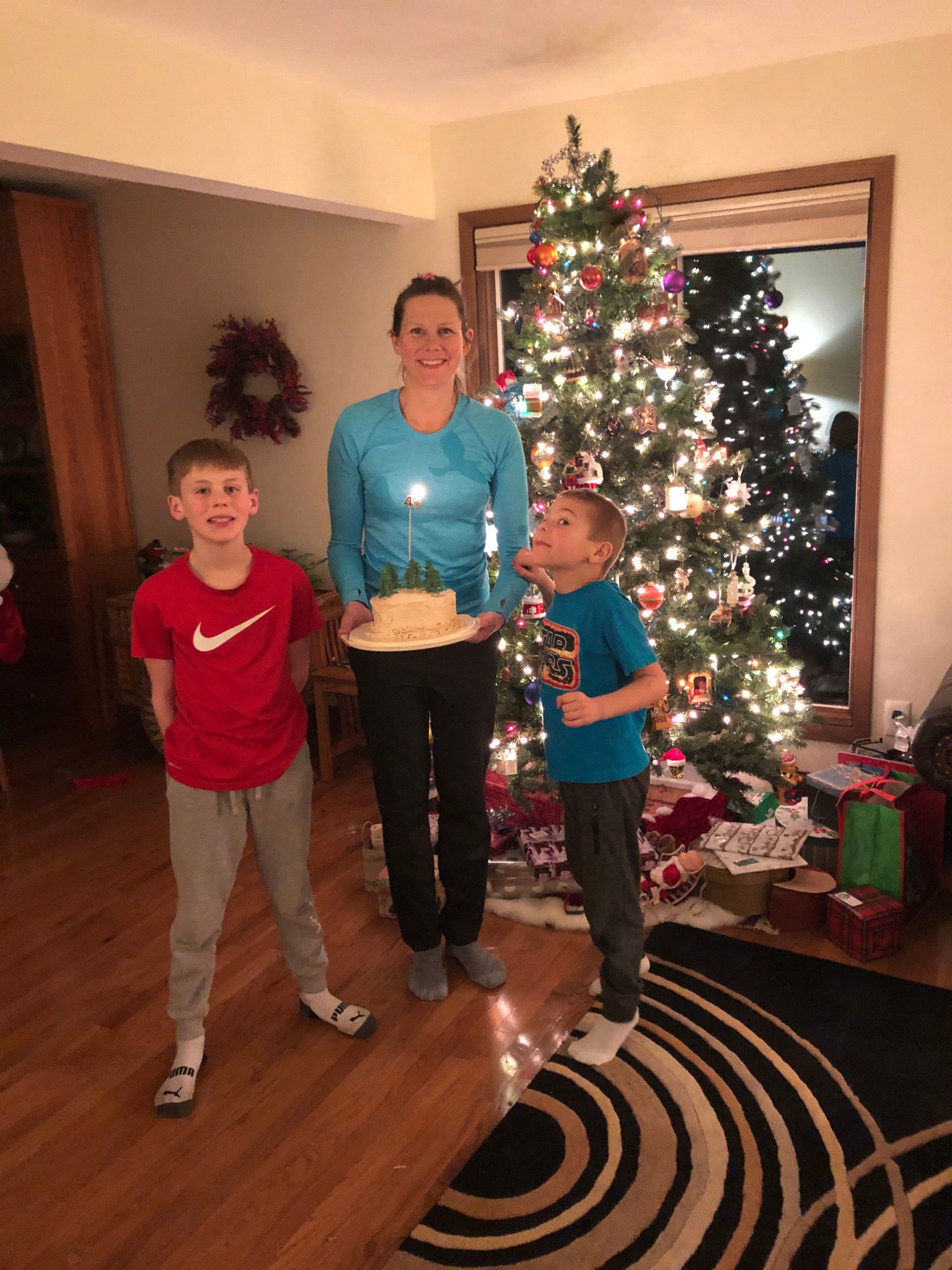
IMG_0119December was a big month for me. I turned 40 and celebrated my 2nd birthday and 2nd Christmas with metastatic breast cancer. Turning 40 was big for me, not because I expected to feel different, but because I have had two drastically different emotions pulling at me, gratitude and disappointment. I was diagnosed with what can be an extremely quick-moving terminal illness when I was 38. I am obviously thankful I have reached my forties and it doesn’t escape me that my luck continues to grow as the years go by. On the other hand, I had big plans for 40 that didn’t involve metastatic breast cancer. My plans specifically involved a big 5-year survival bash that would coincide with turning 40. Had my cancer not returned, this upcoming March would have marked my 5-year survival mark. This is the point at which the chance of a cancer recurrence becomes minimal, a real holy grail for any cancer survivor.

In addition to my somewhat higher state of emotion surrounding my birthday, I am learning that holidays in general, but maybe Christmas most of all bring such an awareness of my probable limited time left. I continue to struggle when I encounter “milestone” situations. This past fall we got to see ninth graders get confirmed in our church. It looked like a special moment shared between the kids and their parents and all I could think was that I might not be up there with my kids when it’s their time. Last Christmas I was really sad because I had to work on what I thought might be one of my last Christmas’s. This year was better, both because I didn’t have to work and I feel more confident that I’ll have more holiday seasons to enjoy, but I still wrestle with the sadness of a shortened life and the anxiety of trying to create the perfect holiday in light of that. My vision of normal life progression is that you spend your time in your 30s, 40s, and 50s as the sandwich years….time where you both care for your own kids, work hard in your career, and begin to take care of your parents. It’s not necessarily a fun or joyful time of life, but you get through it to hit the “glory years” of retirement, the time when you can do whatever you want because, heck, you’re old. I’ve alluded to this before, but one of the hardest things for a super-planner like me is letting go of my plans. Realizing the odds are against me to hit retirement and enjoy my probably overhyped and delusional concept of old age.

I refuse to apologize if this seems like a message of despair. Over the years of writing this blog and talking to different people about my cancer I’ve gotten a fair amount of good-intentioned feedback and comments basically telling me to “keep my chin-up”. I feel like I have kept up a pretty good attitude, but I can’t escape the facts….at this time about 10% of patients with metastatic breast cancer are still living after 10 years. I’ll admit that I didn’t do a bunch of research to support that number for a variety of reasons. No one can really know the specific prognosis for each patient. The first question I asked my doctor…” Could you tell me about how long….” That’s all I could get out before he answered a harsh “No”. I tried a different tactic with my next doctor… ”What’s the longest survival you’ve had for a patient with metastatic breast cancer?” Her answer…” definitely into the double digits…11-12 years”. Fortunately, these numbers are drastically changing. I fully expect the 10% number will go way up in the next 2-5 years. I really believe there is a decent chance a cure will happen before my time is up and even if there isn’t a cure, there is already a large array of options to try when treatments start becoming ineffective. As daunting as it seems at times, I think a realistic vision of my life is a continuing attack on cancer with better, more targeted treatments coming just as one treatment stops working.

The realization I’ve come to with all the contemplating and processing I’ve done this holiday season is that I need to be intentional in my day-to-day life. To that point, shouldn’t we all try to live that way? We all have choices we can make every day that affect how we feel about ourselves and our lives. I became resentful when I first was diagnosed with metastatic breast cancer that my time was being taken away from me. I felt it was unfair that I was having to spend free time in waiting rooms commiserating with a bunch of senior citizens. Over the past 18 months I have been able to manage my appointments and labs so that I only spent about 8 hours total in appointments, scans, and labs in 2019. Some of that was just general good luck with treatments and response, but there was definitely some proactive planning that I did to take back control of my time and I am really proud of that. As I enter 2020, I hope and pray for continued good health and “No Evidence of Disease” or NED, but I also have the confidence and faith that I will be able to manage whatever happens.

Another good scan!

I am happy to report I had another PET scan on October 14th and the results were great!  The area in my sternum that has been showing signs of healing looked stable and no new areas of metastasis were found!  These scans are fairly anxiety-provoking for me.  As I’ve mentioned before, I have definitely had the rug swept out from under me in terms of bad news multiple times in the almost five years that I’ve been living with breast cancer and I think it will just take time for those hard times and bad memories to fade away and be replaced with the feelings of hope that a scan can be a positive reassurance in this disease.  Because I’m just not ready to face any more negative surprises (i.e. cancer has spread to liver, lungs, brain, etc. and more surgery, chemotherapy, and/or radiation would be needed), I tend to assume the worst going into these scans.  I also have noticed that I feel every ache and pain as scans get closer and worry that these are new spots of cancer popping up.  I am sure all of these feelings are fairly normal for cancer patients and I am confident that I will become more comfortable and aware of these feelings with each scan and hopefully become more hopeful with each good scan.

I am guessing my next scan will be sometime in mid-2020.  I am still assessing whether or not to stay with my new oncologist in my current clinic or try moving to the UW Hospital system, which is connected to my clinic, but bigger and much more inconvenient to get to.  Hopefully I won’t have any updates in terms of my health for a while.  I continue to tolerate the medications well and my appointments have decreased from monthly to once every two to three months.  I would say as a metastatic cancer patient, it doesn’t get much better than this.  I am starting to see a future again at least for the next five to ten years where I can see my kids get through middle school and possibly even graduate high school and for that I am so thankful.